Hank Olson
The Long WalkHank Olson is one of the early Long Walk contestants and one of its clearest studies in the collapse of performed confidence. He enters as a swaggering young man who treats walking as a game and adjustment as a strategy, but the event steadily strips that posture away. By the time he attacks the halftrack, his body is catastrophically wounded and his defiance has become both an act of resistance and a final, fatal misreading of the rules.
Identity and Introduction
Olson introduces himself to Ray Garraty and Peter McVries with the slogan-like declaration, "More lambs to the slaughter. Hank Olson's the name. Walking is my game." The words are striking because they combine awareness of the Walk's violence with an apparently cheerful confidence in his ability to master it. He offers no trace of a smile, making the boast less like casual joking than a deliberately hard public identity.
At the selection, Olson receives number 70 and remains with The Major longer than the others. The Major laughs at something Olson says and claps him on the back, an exchange that gives Olson a moment of conspicuous recognition. When he returns, Olson reports that he told The Major to keep a lot of money on short call and that The Major answered by telling him to give them hell. Olson presents the encounter as an endorsement: he wants the others to see him as eager, prepared, and welcomed by the authority governing the contest.
Confidence Under Pressure
Olson's confidence becomes less stable as the Walk continues. When another contestant insists that warnings can simply be adjusted to, Olson's early philosophy is represented by the same general logic: survival depends on managing the system rather than fearing it. Yet later, as the field contracts, Garraty notices that Olson's voice has softened. Garraty likes him despite his brass-balls outer face, but also recognizes that Olson is becoming frightened. The change matters because Olson does not begin as a visibly fragile figure; fear appears as a corrosion beneath a deliberately hardened surface.
The Walk repeatedly turns this private fear into public arithmetic. After two contestants disappear, the remaining odds are said to have shifted infinitesimally in favor of those left. At roughly eighty miles, McVries and Garraty calculate that they are a quarter of the way home, while after ninety-nine miles only thirty-six contestants have been eliminated. The apparent progress offers no real security. The declining body count makes survival feel measurable, but each reduction also confirms that the rules convert individual suffering into statistics. Olson's own trajectory will eventually be absorbed into that same accounting.
Attack on the Halftrack
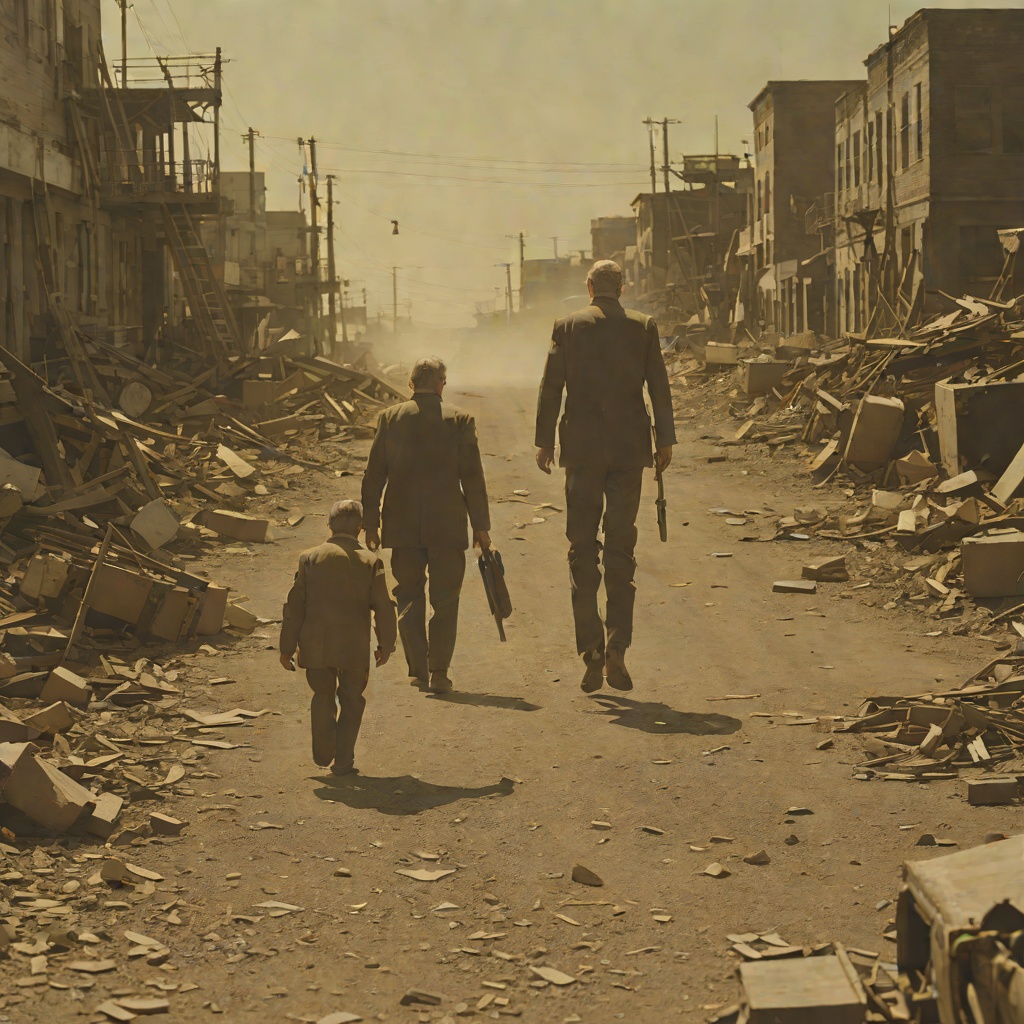
Olson's decisive action occurs when the soldiers and the halftrack become the immediate focus of his resistance. He never slows as he approaches the soft shoulder and begins climbing painfully up the side of the vehicle. Abraham identifies him aloud, startled that the contestant is Hank Olson. The soldiers respond in perfect coordination, bringing their guns around as a group.
Olson grabs the barrel of the nearest carbine and yanks it from the soldier's hands. The weapon clatters into the crowd, which recoils and screams as though the gun itself were alive. The gesture briefly reverses the expected arrangement of power: the monitored walker physically disarms one of the armed enforcers, and the spectators become frightened witnesses rather than merely an approving audience.
The reversal lasts only moments. Another gun fires, and the bullet passes through Olson's belly and out his back. He is not immediately killed. Instead, he sits up while the guns remain trained on him, and the soldiers appear almost curious about what he will do next. His continued movement makes the violence more disturbing: the event does not simply end a body; it keeps that body within the logic of the Walk.
Wounded Defiance and Death
Olson slowly regains his feet with his hands crossed over his abdomen. He sniffs the air for direction, turns toward the route, and staggers onward. His intestines slip through his fingers and hang against his groin; he bends as though trying to retrieve them, vomits blood and bile, and then resumes walking bent over. The grotesque physical detail destroys the heroic image suggested by his earlier bravado, but his face is described as sweetly calm. The calm is not a restoration of confidence. It is the eerie persistence of motion after the distinction between will and automatic survival has nearly disappeared.
Garraty and McVries walk backward for a time, watching Olson kneel and then rise again. Olson stands astride the white line and raises both hands toward the sky before shouting, "I DID IT WRONG!" He falls flat and dead. The soldiers fire two more bullets into him and drag him from the road, completing the procedural violence after his body has already stopped moving.
Olson's final cry gives his death an inward dimension absent from the official mechanics of warnings and shooting. He does not accuse the soldiers or explain what he meant; he identifies himself as having failed at something. The statement can be heard as the collapse of his original strategy of adjustment, as the recognition that confidence and physical endurance could not make the Walk intelligible or survivable, or as the last expression of a contestant who has discovered that the rules were never a game he could correctly play.
Relationships and Narrative Role
Olson's connection with Garraty is brief but significant. Garraty initially responds to his aggressive exterior with suspicion and then develops genuine liking for him, precisely because the apparent toughness begins to reveal fear. Olson also addresses McVries during the later deterioration, telling him that the "baggy feeling" has not gone away. The remark turns an earlier bodily unease into a persistent condition rather than a temporary discomfort, and Olson's admission gives the other walkers a glimpse of the psychological burden behind his performance.
After Olson's death, Garraty insists that Olson had been alive when he spoke to him. For Garraty, this is the most important fact of the experience: Olson was not merely an already-finished object waiting to be removed. McVries counters that Olson is only a number, part of the body count, number fifty-three, and that his death means only that the survivors are a little closer to the end. The disagreement places Olson between two ways of seeing the Walk. Garraty preserves the dying man's personhood through memory and witness; McVries describes the system's colder truth, in which a name and a voice are converted into a numerical reduction.
Olson's death also recalls the earlier deaths of Curley, Ewing, Zuck, and Travin. Curley is shot after slowing below the required pace, his body disappearing beneath the spectacle of the crowd and the firing carbines. Ewing is pulled aside and shot by soldiers after falling behind. Travin is watched, waited on, and killed while suffering diarrhea, his physical humiliation becoming part of the event's public discipline. Olson differs because he actively attacks the enforcement vehicle, yet the result is still absorbed into the same system: he becomes another eliminated contestant, another body removed from the road, another figure against whom the survivors measure their shrinking odds.
Change and Significance
Olson's arc moves from public mastery to private fear, then from fear to physical resistance, and finally from resistance to self-condemnation. At the beginning, his identity is built from slogans, masculine bravado, and apparent proximity to authority. Near the end, the only remaining proof of that identity is his refusal to stop moving after a mortal wound. The gesture is courageous in its immediate force, but the Walk gives courage no emancipatory outcome. Even successful defiance cannot change the structure that waits with rifles, warnings, and a chronometer.
The aftermath makes the transformation complete. Soon after witnessing Olson's death, Garraty tries to find a pattern in what has happened and draws comfort from McVries's presence. He argues that Olson was alive until the soldiers shot him; McVries replies that Olson was simply number fifty-three. Later, when Garraty himself approaches elimination, he imagines that the others would continue walking even if he had received his ticket, with only an official record naming him, his number, and the mile at which he fell. Olson thus becomes a template for Garraty's fear: a living person can vanish into an entry in the records almost instantly.
Olson's attack is therefore not merely an isolated burst of violence. It is the point at which the Walk's competing meanings collide. The contestant understands himself as an agent capable of choosing action; the soldiers treat him as a dangerous body within a regulated spectacle; the crowd recoils, watches, and then allows the machinery to resume; and the survivors argue over whether the dead retain an identity beyond their number. His final collapse demonstrates the event's central cruelty: the Walk can acknowledge individual courage only by converting it into another elimination.